
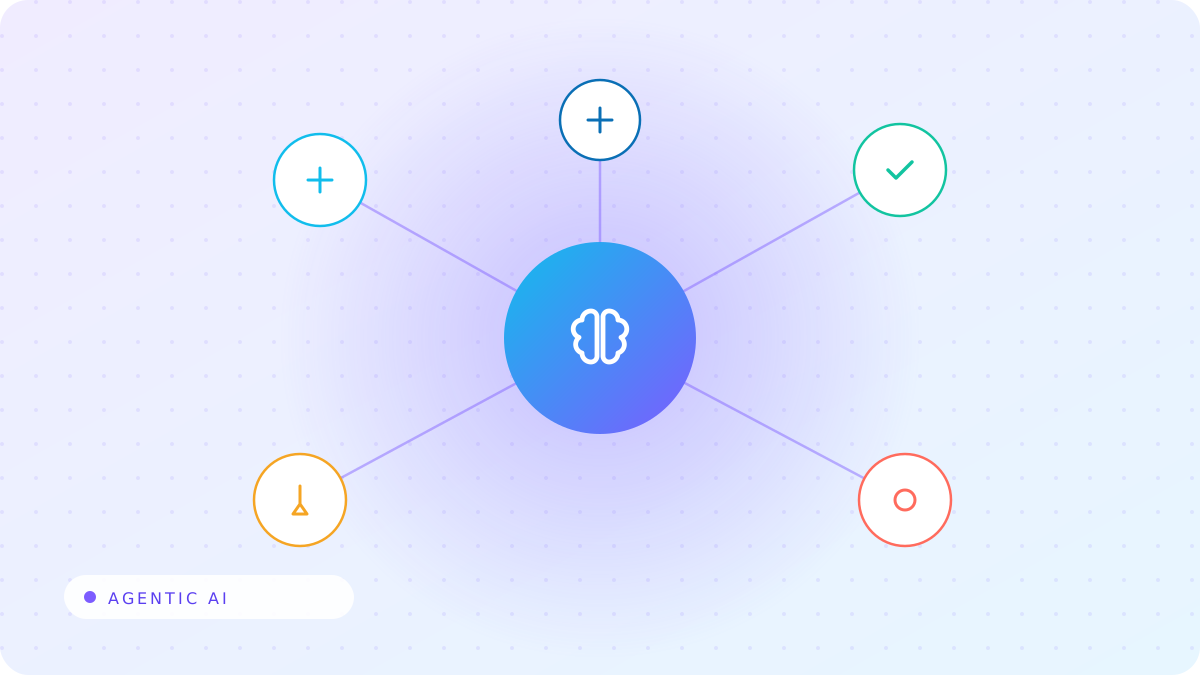
Why goal-driven AI agents are the next step beyond conversational AI — and how enterprises can adopt them safely.
Conversational AI proved that machines can understand language and respond in kind. It was a breakthrough — but a chatbot still waits for you. Agentic AI flips that relationship: instead of answering a question, an agent is given a goal, then plans, calls tools, observes the results and iterates until the goal is met. The shift from responding to acting is what makes this generation genuinely different.
What actually makes an AI "agentic"
The term gets used loosely, so it helps to be precise. A system is agentic when it combines four capabilities into a single loop:
- Planning — decomposing a high-level objective into ordered, executable steps.
- Tool use — calling APIs, querying databases, running code or browsing systems to gather facts and take action.
- Memory — carrying context across steps and sessions so the agent doesn't start from zero each time.
- Reflection — checking its own output, recovering from errors and deciding whether the goal is genuinely complete.
Remove any one of these and you're back to a smarter chatbot. Put them together and you have something that can own a task end to end.
From conversation to operations
For most enterprises the opportunity is not a flashier assistant — it's autonomous operations. Agents are already proving themselves on work that is high-volume, rules-heavy and tedious for people:
- Triaging support tickets, enriching them with account context and drafting a resolution for an agent to approve.
- Running procurement checks — comparing quotes, validating vendors and flagging exceptions.
- Compiling recurring reports by pulling from several systems and reconciling the numbers.
- Monitoring pipelines and infrastructure, then opening a ticket or rolling back when something drifts.
The pattern is consistent: the agent handles the 80% that is routine, and a human handles the 20% that needs judgement.
The goal of an enterprise agent is not to remove people from the loop. It is to make sure people only spend their time on the decisions that actually need them.
Adopting agents safely
Autonomy without controls is a liability, not a feature. The organisations getting real value treat guardrails as part of the design, not an add-on:
- Scoped permissions — each agent gets the narrowest set of credentials and actions it needs, and nothing more.
- Human-in-the-loop approvals — anything irreversible or high-value pauses for a person to confirm.
- Full auditability — every plan, tool call and decision is logged, so behaviour can be reviewed and explained.
- Bounded autonomy — clear stop conditions, spend limits and timeouts prevent runaway loops.
A pragmatic way to start
Begin narrow. Pick one well-understood process with clear success criteria and a tolerant failure mode. Instrument it so you can measure outcomes — resolution time, accuracy, cost per task — against your current baseline. Run the agent alongside your existing process first, with a human approving each action, and only widen its autonomy once the data earns your trust.
Agentic AI is not magic, and it is not a science-fair demo. Treated as an operational capability — measured, governed and scoped — it becomes one of the most practical levers an enterprise has to reclaim time and scale its best work.
If you're exploring where agents fit in your operations, our team can help you identify the right first use case and the guardrails to ship it safely.